

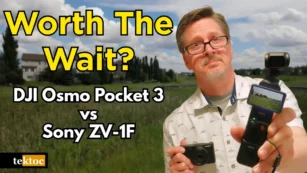
I’ll be honest with you right up front: I sat on the fence about the DJI Osmo Pocket 3 for two full years. The price never quite made sense to me, so instead I picked up a used Sony ZV-1F and made peace with that decision. Then the DJI Osmo Pocket 4 came out earlier this year, the Pocket 3 dropped in price, and I finally pulled the trigger. This post walks through what I found, and why — if you’ve been eyeing this camera the same way I was — right now might be your best window to grab one.
What’s Actually Different Between These Two Cameras
On paper, the Sony ZV-1F and the DJI Osmo Pocket 3 look surprisingly similar. Both use a 1-inch sensor, both have a fixed 20mm lens, and both are built with video as the priority rather than stills. If you just read the spec sheets side by side, you might wonder why one costs noticeably more than the other.
The answer comes down to one part: the gimbal.
The Sony relies on digital stabilization, meaning the camera’s software smooths out the footage after it’s captured. That works reasonably well in good light, but it starts to struggle once things get dim — the image can turn soft and a little jittery. The Osmo Pocket 3, on the other hand, uses a genuine three-axis mechanical gimbal. The lens itself physically stays level in real time, which makes an enormous difference in two situations: walking-and-talking shots, and low-light filming. That same gimbal is also what powers the camera’s “follow mode,” where the lens tracks your face automatically as you move — something a fixed-lens camera simply can’t replicate without an expensive add-on gimbal of its own.
There’s a practical side benefit here too, one that doesn’t show up in any spec sheet: the Osmo Pocket 3 is genuinely tiny and unassuming. If you’ve ever felt a little self-conscious filming yourself in public, holding a small stick-shaped camera draws a lot less attention than holding what looks like a “real” camera up to your face.
Menus, Accessories, and Everyday Practicality
One thing I appreciated once I got the Pocket 3 set up is how straightforward DJI has made the interface. If you’ve ever used a DJI Action camera, the menu system will feel immediately familiar — exposure, ISO, shutter speed, and white balance are all there if you want manual control, but everything is laid out simply enough that you’re not hunting through submenus to find a basic setting.
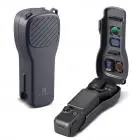
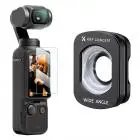
For accessories, DJI’s included case only covers about half the camera, so I picked up a clamshell-style protective case from K&F Concept that fully encloses it and has slots to store extra magnetic lenses, including a wide-angle lens I use regularly. If you’re someone who likes to protect your gear without overspending, that’s worth a look alongside the camera itself — both are linked in the video description and at the bottom of this post.
So, Is It Worth It?
After testing both cameras side by side on the same walk, in daylight and after dark, my honest takeaway is this: I regret waiting. The Pocket 3 handled low light more cleanly, tracked me perfectly in follow mode, and was simply easier to grab and start using without fiddling with settings first. The Sony ZV-1 isn’t a bad camera by any stretch — it’s well built and has served me fine — but for anyone whose priority is video rather than stills, the gimbal-based design is where the Pocket-style cameras have a real edge.
If you’ve been debating the Sony ZV-1F vs DJI Osmo Pocket 3 question yourself, and video is your main focus, I’d say this: don’t wait two years like I did. With the Pocket 4 now out and pulling attention away from it, the Pocket 3 is sitting at a genuinely good price for what it offers.
Curious how these two actually compare on screen? The full video walks through the unboxing and a real side-by-side test in the park — link at the top of this post.
Products Featured In This Post and Video
(The links below are affiliate links. I may earn a commission on any purchases made which does not affect the price you pay. Affiliate commissions support the operation of this site and my YouTube channel.)
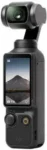
DJI Osmo Pocket 3 Camera: https://amzn.to/4yBapXz
An absolutely brilliant camera for vlogging and travel that delivers buttery-smooth stabilization from it’s motorized gimbal head, along with exceptional low-light performance.
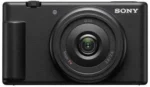
Sony ZV-1F Compact Camera: https://amzn.to/4yF4nVG
Sony’s fixed-lens and fixed-focal-length, video-first travel camera. Excellent image and video quality from its 1-inch sensor, small, light and compact. While it lacks the benefits of the built-in gimbal, that also makes it more rugged and able to withstand being knocked about.
K&F Concept Osmo Pocket 3 Case: https://amzn.to/4fklDIj
Indispensable protection for your Osmo Pocket 3 and an improvement over the original DJI protected cover that comes with the camera.
K&F Concept Wide Angle Lens: https://amzn.to/45lsoUf
This wide angle lens is brilliant for vlogging, allowing you to include more of your surroundings in the shot while still minimizing distortion.
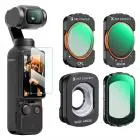
K&F Concept Wide Angle Lens + 3 Filter Pack: https://amzn.to/45mrffe
Great value in this 4-pack kit! You get the 16mm wide-angle lens (which I think is a must-have) along with CPL, variable ND and black diffusion filters.
Recent Posts
- The DJI Osmo Pocket 3: Why I Waited Two Years (and Why You Shouldn’t)
- Password Security Made Simple: How I Finally Stopped Worrying About My Passwords
- Windows 11 26H2 Update: What’s Actually Changing
- AMD Brings Back the Ryzen 7 5800X3D — And a Few Changes Here at tektoc
- Why RAM Prices Are Skyrocketing (And Why Your Old Computer Is Now More Valuable Than Ever)
Discover more from tektoc
Subscribe to get the latest posts sent to your email.
